
The Haunted Churchyard
←Previous Entry Read Next Entry→Web Diary Entry 2
I find myself once again on a day off. I’ve just set up my new coffee maker, since the bug invasion which laid siege to its predecessor has been taken care of (the simple joys of living in a garden apartment with an “exposed brick” wall).
Buckle in folks, this ended up being a long one.
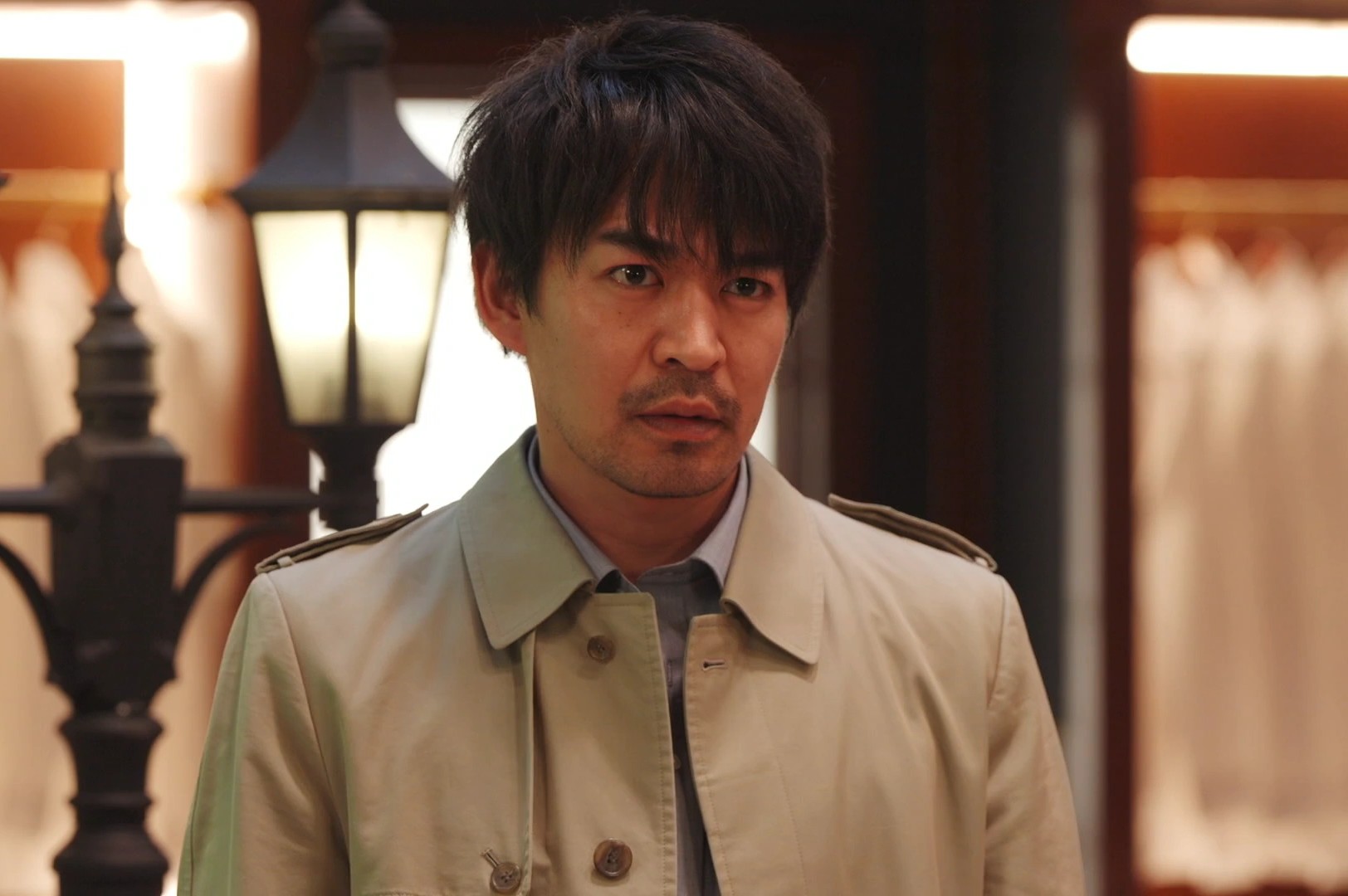
I started catching up on the new Kamen Rider series, Kamen Rider Zeztz. I’m still trying to decide if I’ll continue and finish it once its run is over in a few months. On the one hand, there are so few Kamen Rider series that are easily accessible, it's very nice being able to watch all the episodes conveniently on Youtube. On the other hand, while the series is still fun, its missing much of the charm of earlier entries. My favorite seasons of the show have a tactile and grainy warmth that I feel is lost after the first few Heisei phase 2 series, over 10 years ago now, though there have been some great entries since. I think most of this is due to the lower fidelity of older digital video. But even if the aesthetics of Zeztz are less appealing to me, there are still a lot of outdoor locations and awesome practical suit effects, and one of the side characters is a disheveled, middle-aged, Japanese detective, and I love those guys.
After spending so much time with Fallout New Vegas earlier this year, I’ve been looking for the next game to draw me in to the same degree. I’m already limited by the capacity of my laptop, which is quite the workhorse all things considered, but isn’t designed for most modern games’ hardware requirements. Unfortunately, I haven’t been in the mood for isometric computer RPGs, meaning I haven’t had much traction trying to get back into Pillars of Eternity II: Deadfire. I loved the first game so much, and I’m confident I’ll enjoy the second as well when I find myself in the mood for it, but it is not yet time. So instead, I thought I’d try to go back to the well from which I first got into games. The game that really got me into the hobby was Octopath Traveler, a charming and robust JRPG from 2018, which pioneered the “HD-2D” art style for graphics. It has a sort of diorama quality about it that I enjoy immensely, like a pixel art version of the miniature environments that go with model trains. JRPG, for those who don’t know, refers to Japanese Role Playing Game, or an RPG in the Japanese style, defined originally by games like Dragon Quest or Final Fantasy. They differ significantly from isometric CRPGs like Pillars or open world first-person RPGs like New Vegas or Skyrim.
So, all that to say, I’ve been very interested in JRPGs recently. Last year, in addition to Octopath, I played one of the classics of the genre, Earthbound, or as it was originally titled, Mother 2, though it also fell victim to the busy summer, and I have yet to finish it. This year, I have a list of several JRPG games which I plan to get to eventually, including Shining Force (an early example of combining the genre with tactics elements), Golden Sun, and Chrono Trigger, perhaps one of the most famous games of its type. I have briefly dabbled in all of these, but I can only play so many games at once. The game that has endeared itself to me the most so far however, is the 1997 3D JRPG Grandia.
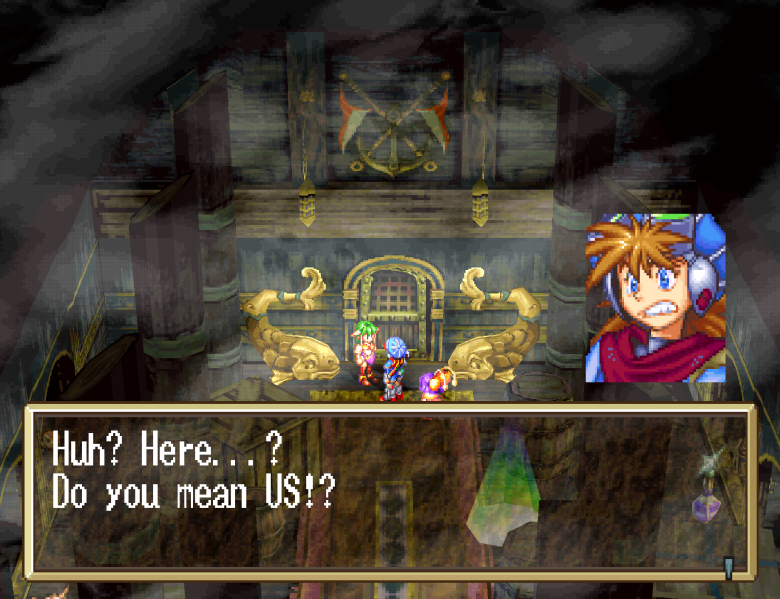
Set in a fantasy-industrial setting, with a beautiful 90’s anime aesthetic, Grandia is a thoroughly charming game. The character portraits in particular are so expressive and joyful, with several different images to fit with whatever emotion is reflected in the dialogue. And while the sprites are obviously much less detailed, their victory animations are delightful, especially Sue and Puffy’s cheer, and Feena’s determined fistpump. For me personally its greatest strength is its character dynamics. The relationships between Justin and his mother Lilly, his friend Sue, and the accomplished adventurer Feena are all really sweet and believable. The writing in general is really considered, and the characters feel true to their ages in a way that many similar stories don’t capture. At times there’s a kind of innocence to it that really subverts a lot of tired tropes in adjacent media, to the effect that it feels a lot more mature, while still broadly capturing a freeing feeling of wonder. It doesn’t entirely avoid cliché situations, but it builds up enough goodwill with its broader quality that they don’t feel lazy.
In addition to Grandia, I have been playing Persona 4, a much more popular game from a more famous franchise. Persona games are less traditional JRPGs, blending the dungeons and battle systems common to the genre with visual novel segments, including schedules and social elements factored in. Persona 4 (as well as the other games in the broader franchise), is set in contemporary times with a hidden fantastical other-world existing alongside it. In 4’s case, this is a small Japanese town, suddenly beset by a series of strange murders, which are soon revealed to be connected to the supernatural. The aesthetics of the Persona games seem to be a large part of their appeal, and the late 2000’s fashion and design style are right up my alley. The jazz-fusion soundtracks are also famous for a reason, and are one of the cornerstones of the franchise. Finally, the game includes another disheveled, middle-aged Japanese detective, the protagonist’s uncle. This inclusion alone scores the game points in its favor as far as I’m concerned.
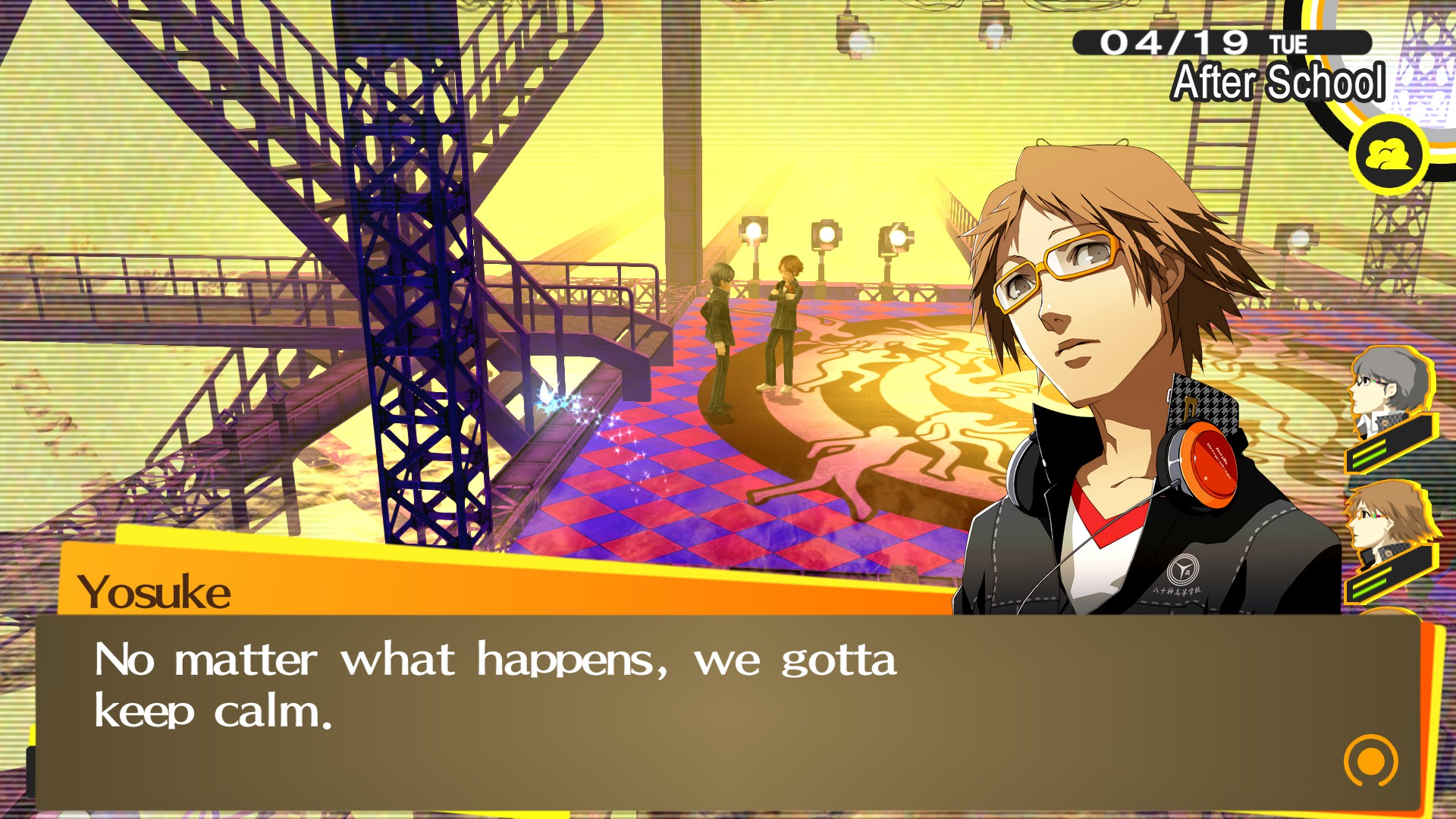
Referring back to the topic from last post about problematic components in media I enjoy, Persona 4 is one of these cases, somewhat famously so. I have yet to encounter the main instances players often discuss, so I won’t speak on those much as of yet, though they are certainly of interest to me since they are related to queerness and gender. Mostly the only problems I have encountered so far are some hints of misogyny, particularly with Yukiko’s character, but I will withhold judgment until I see where the game is going with her as I progress. So far, I think most of what I’ll get out of the Persona 4 experience is related to its atmosphere, design and aesthetics, more so than its characters or themes, because I have yet to connect much with its cast (though I don’t dislike them), and I’m not sure I have much confidence in its ability to adequately execute its themes. The game centers on concept of the dark or shameful parts of ourselves that we hide from the outside world, and even from our own self-perception. It’s a great idea, and definitely a topic I’m interested in seeing explored, so we’ll see if it lives up to the potential.
The only problem with either of these games trying to fill the New Vegas void, is that what I’m really looking for is what I can only describe as “big-screen-desk-games.” Grandia is on my Switch, rather than the laptop, and while I suppose I could play it at my desk, it wouldn’t scratch the itch. Its a couch in the living room game. Persona on the other hand, is a big-screen game (by big-screen I mean the 15” display of my laptop), and I have even been playing it at my desk, but it feels claustrophobic in a way, with limited movement and small disconnected environments, and this feeling keeps it from fulfilling the requirements. I realize that it sounds like it’s not the desk or screen at all, and that the missing factor is that I really want another open world or first person game, but this is not the case. I have tried a few others, like Skyrim, Fallout 3, or The Outer Worlds (all discounted or in a shared library thankfully), and have found them either too open and aimless, or boring in the case of The Outer Worlds unfortunately. That game is another joint by the same studio as New Vegas and Pillars of Eternity, and so even though its underwhelming reputation preceded it, I had naively hoped for a better outcome. That wasn’t entirely wrong of me, because many people who enjoy New Vegas also consider Pillars boring, and obviously that game clicked with me extremely well. But nonetheless, Outer Worlds was unable to repeat this trick, though I do intend to give it a proper shot in the future.
Another part of the requirements for a New Vegas thirst-quencher is that it be compatible with a controller. There are many games I play with keyboard controls, like the isometric CRPGs I have already mentioned, and games like Resident Evil 2 or 1999’s Nocturne (a forgotten gem by the way if you like old PC games). But keyboard controls require sitting up at my desk in my uncushioned folding chair, rather than languishing comfortably in my lounge chair (one day perhaps I will have the extra money to buy a comfortable desk chair and solve this problem, but it is not this day). This controller requirement rules out several older RPGs such as Morrowind or Vampire the Masquerade: Bloodlines, or immersive sims like Deus Ex or Thief. It must be a comfortable game.
I think this was all a very long way to say that I’m beginning to learn something. I don’t think I can find a game to fill the New Vegas void. Looking back on it I can’t entirely pinpoint why this buggy, brown-and-orange game touched me in the way it did. I think we often spend copious time analyzing art that affects us instead of just accepting the fact that it did.
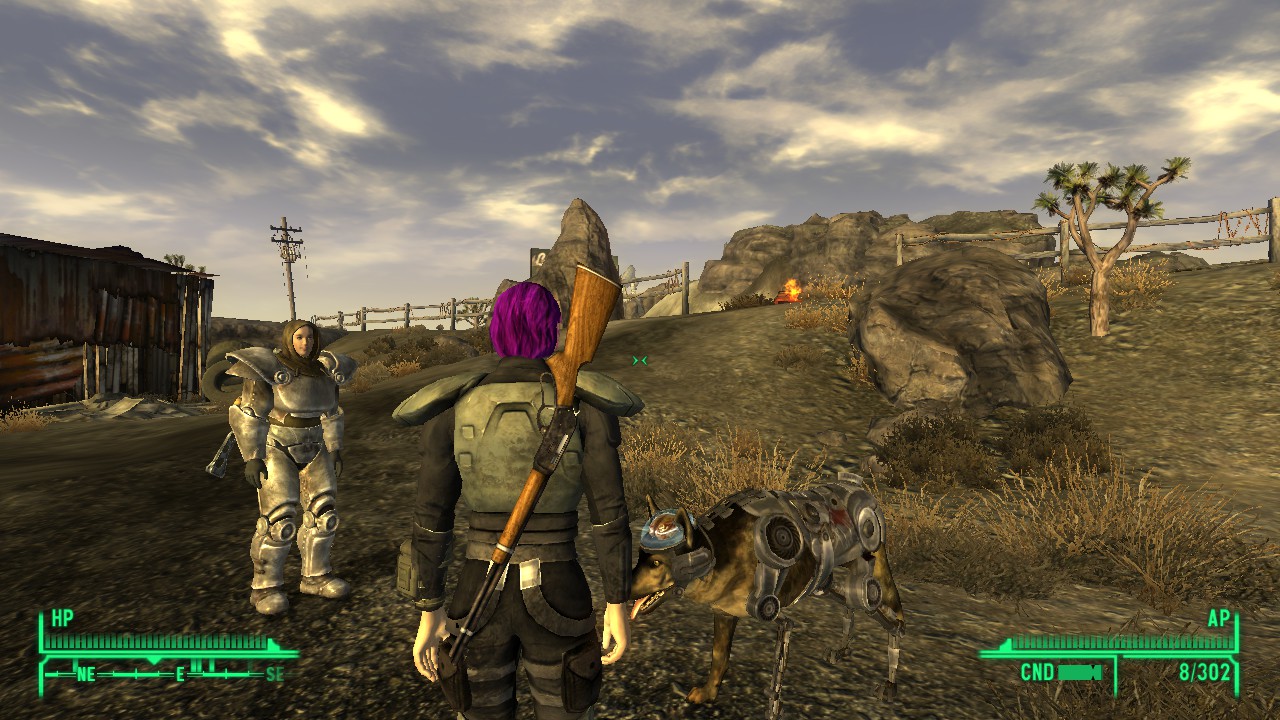
That’s not to say I don’t have ideas. I know why a character like Veronica resonated with me, for example. Her quest sees her coming to terms with the fact that her values don’t align anymore with those of the culture in which she was raised. She tries to explain the conclusions she has come to, but in the end, her views are rejected. Truthfully, she is rejected. She is given the choice to stay in the community, yes, but it would mean giving up so much of who she is, sweeping her true ideals under the rug, and living the rest of her life without integrity. In reality, she has no choice at all.
I also think New Vegas was simply an important outlet for me in a time where I feel increasingly powerless to do good in the world, or even just see it done by others. Many games probably could have provided this experience for me, but New Vegas was the one that did. In a similar way, I think the movement and free roam of it all soothed my spirit in a cold winter where leaving the house was extra miserable, though its never really easy for me.
Lastly, New Vegas is a story haunted by the past. Every major faction is trying to recapture some aspect of the prewar world, and because of this they leave further war and violence in their wakes. Their obsession with the past prevents them from making any meaningful progress in the post-apocalypse. As someone who often seeks out nostalgia, for both the era I grew up and times I never saw, I think this is another reason I connected with the game. It forced me to think about my relationship to seeking the past, and how my fascination with the media and fixtures of bygone days affects the way I move in the world. I can enjoy the warm glow of a CRT and the artistic dedication of an old anime OVA without living in the past, and especially without idolizing regressive values. I can even be dissatisfied with the way things are, and see the ways they were better before, but also recognize the ways in which they were worse, and the advantages that the progression of time has given us.
Those are simple and small reasons for its resonance though, pieces of why I felt so much from this game, but not a comprehensive reading. Rather than attempt to find another game to seal the vacuum left behind, I might just have to let that feeling stay. In an era of media consumption where we have so much available to us that we forget most of what we see, perhaps I should simply appreciate that something stayed with me so intensely.
←Previous Entry Read Next Entry→